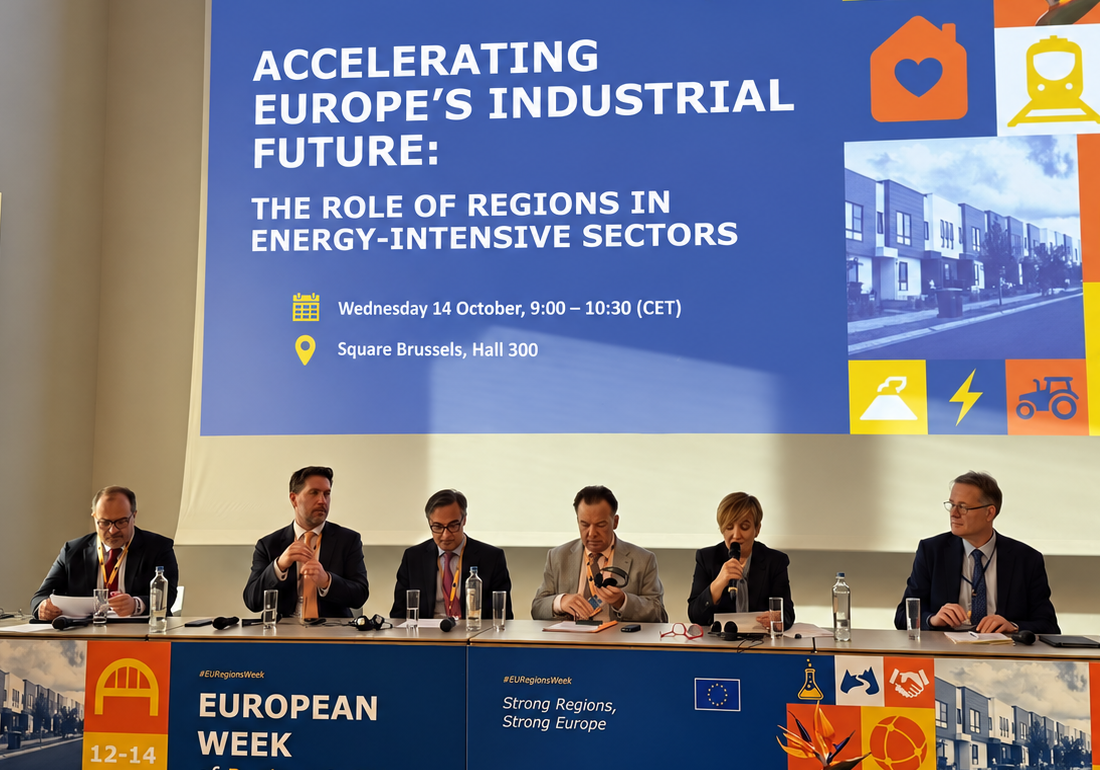
Brussels, 14 October 2026 – Europe’s energy-intensive industries are already decarbonising, but EU policy still treats regions as executors rather than strategists. That was the shared message of the high-level debate “Accelerating Europe’s Industrial Future: The Role of Regions in Energy-Intensive Sectors”, held at Square Brussels during the European Week of Regions and Cities.
Moderated by Thomas Wobben of the European Committee of the Regions, the panel brought together regional leaders and network representatives from Valencia, Mazovia, Centre-Val de Loire, Wales and the European Chemical Regions Network (ECRN). The timing was pointed: the session ran in parallel with a plenary vote on the European Industrial Accelerator Act and the automotive position.
Against a backdrop of rising energy costs, aggressive international competition and complex regulatory frameworks, participants agreed that Europe’s industrial sovereignty and climate objectives cannot be achieved without strong regional leadership. Energy-intensive sectors such as ceramics, chemicals and steel face critical hurdles, and regions are the frontline of EU competitiveness.
Voices from the regions
Valencia: industry is already in the transition
Marián Cano, Regional Minister for Industry, Tourism, Innovation and Commerce of the Region of Valencia (Spain), opened by grounding the debate in the Valencian ceramic cluster, one of the world’s leading export-oriented ceramic industries and a clear example of the decarbonisation challenges facing energy-intensive sectors.
Her argument was direct: industry is not waiting for the transition; it is already in it. Companies have been investing in efficiency, electrification and hydrogen for years. The real bottleneck is not technology but access to affordable decarbonised energy and adequate grid infrastructure. Together with the Emilia-Romagna region, Valencia has raised this directly with the EU institutions, defending the principle that the climate transition works better with industry than at its expense.
“We fully support Europe’s climate ambitions, but we also believe that regulation must be aligned with the real pace of innovation and help strengthen the investment capacity of the companies that are already leading the decarbonization journey.”
Mazovia: regions are missing from the rulebook
Adam Struzik, CoR member and Marshal of the Mazovia Region (Poland), Poland’s largest region and a major chemical hub, pointed to a structural problem: the role of regions is simply not defined in key instruments such as the Critical Chemicals Alliance or the Industrial Accelerator Act. National reform and partnership plans are national in name and in practice, leaving regions as executors rather than strategists.
“Europe does not have to choose between climate ambitions and a strong industry. However, the success of the transformation cannot be measured solely by emission reductions – the true measure is retaining jobs, investments, and strategic sectors, such as the chemical industry, in Europe. Achieving this requires closer collaboration between the central administration and the regions.”
Centre-Val de Loire: what about the non-accelerated zones?
Olivier Beatrix, Regional Councillor for reindustrialisation, relocation of the economy and investments of the Region of Centre-Val de Loire (France), highlighted the logic of industrial acceleration zones, which concentrate support around cheap energy, nuclear power and strong connectivity. He welcomed the ambition but raised a question the moderator echoed: what happens to the non-accelerated zones? Lorraine and Picardy, former steel and coal areas now below 75% of the EU average, barely feature in Commission documents, despite being exactly the kind of places the transition must not leave behind.
“Reindustrialisation starts with the territories. Regions know their industrial ecosystems, their companies and their strengths, and they are best placed to turn these assets into concrete investment projects. Our role is to attract and support these projects by addressing the essential conditions for industry such as energy, land, water and skilled labour.”
Wales: net zero as a vehicle for reindustrialisation
Ben Burggraaf, CEO of Net Zero Industry Wales (UK), brought a different angle. Wales has lost 40,000 to 50,000 manufacturing jobs since the 1980s and is now using the net zero transition as a vehicle for reindustrialisation. Net Zero Industry Wales is a public-private non-profit that drives policy bottom-up, informed by what industry actually needs rather than what governments assume it needs.
The South Wales industrial cluster accounts for 16 million tonnes of emissions, while the Celtic Freeport is focused on hydrogen, CO2 storage and floating offshore wind. On skills, Burggraaf pushed back against the label “net zero jobs”, arguing that 80 to 90% of skills in steel and petrochemicals are fully transferable and that framing them as a new category creates unnecessary confusion in education systems.
“Net zero industry Wales is created to make happen what otherwise wouldn’t, doing things differently and delivering industrial transformation in partnership between the public & private sector.”
ECRN: regions keep being sidelined
Folco Ciulli, Executive Director of the European Chemical Regions Network (ECRN), was the most pointed. He argued that the EU has spent 25 years writing rules that open markets rather than doing industrial policy.
ECRN has 20 members, 18 of which took part in the Critical Chemicals Alliance. The network chaired one of its four working groups and contributed across all of them, meeting two to three times a week for eight months. When the work was done, the Commission handed the outputs to the Joint Research Centre (JRC) for re-elaboration. His conclusion: regions are the real voice for industrial renewal, but they keep being sidelined.
Built with the regions, delivered through them
The debate closed on a clear call: to decarbonise without risking deindustrialisation, upcoming EU legislation must ensure streamlined regulation, affordable clean power and tailored regional investment, and it must give regions a defined role in shaping it.
“Europe cannot decarbonize without industry, and it cannot keep its industry without its regions. EU initiatives will only deliver if they are built together with the regions and implemented through them.”
— Folco Ciulli, Executive Director, ECRN